Product Description of LSAW Steel Pipe:
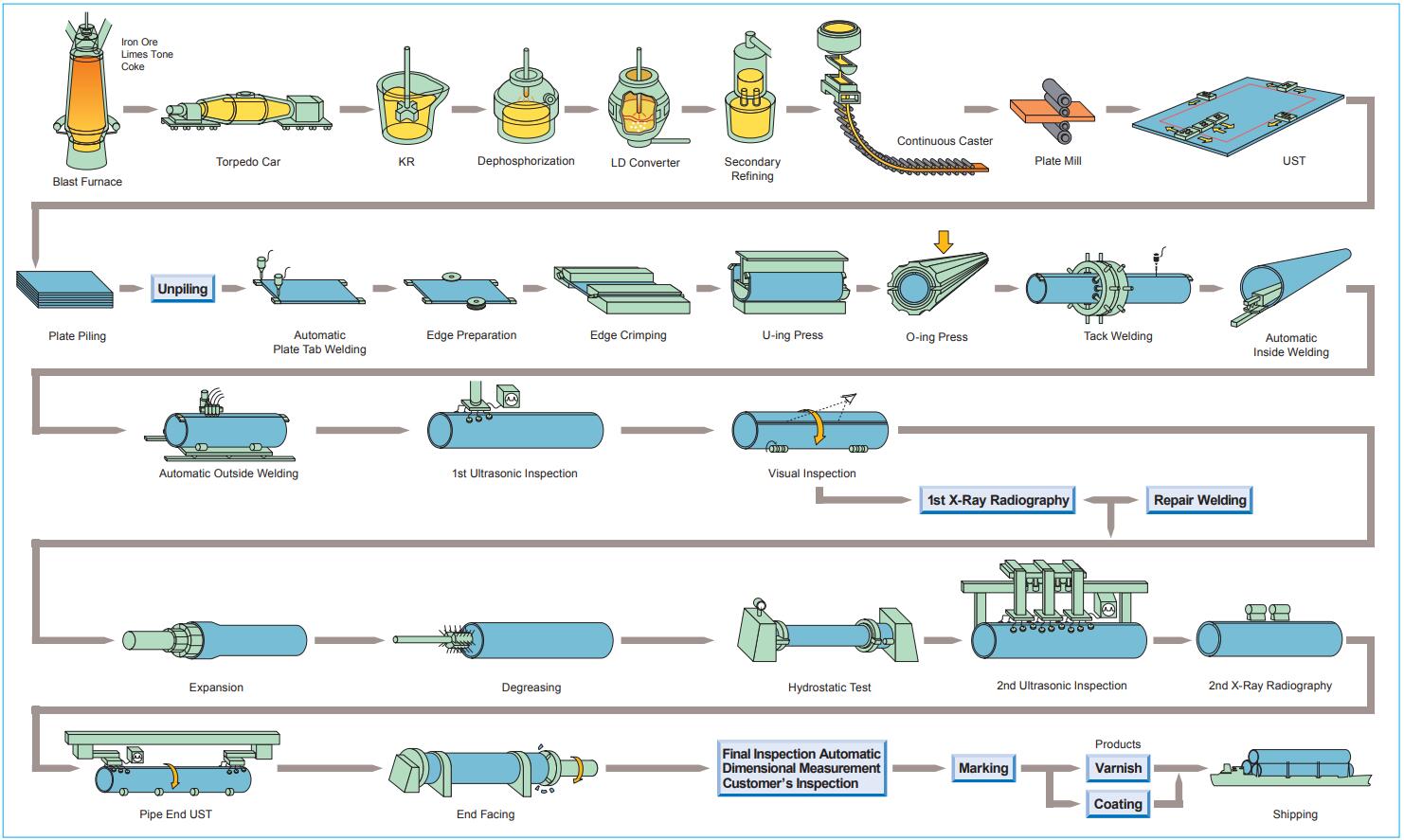
LSAW (Longitudinally Submerged Arc Welded) steel pipe, also known as straight seam submerged arc welded pipe, is a large-diameter welded steel pipe manufactured from steel plates. It is widely recognized for its high dimensional accuracy, strong weld integrity, and ability to withstand high pressure, making it the preferred choice for long-distance energy transmission and critical structural applications.
Types of LSAW Steel Pipe
Type | Process Characteristics | Advantages | Typical Applications |
UOE | Plate edges pre-bent, then formed into "U" and "O" shapes using hydraulic presses, welded, and finally mechanically expanded. | Highest efficiency, excellent dimensional accuracy, low residual stress. | Large-scale, high-quality large-diameter pipelines (e.g., long-distance oil & gas transmission). |
JCOE | Plate is progressively bent in "J-C-O" sequences, then welded and expanded. | High flexibility, lower investment cost, suitable for small-to-medium batch production. | The most widely used process; ideal for multi-specification, multi-variety production. |
Product Features & Advantages of LSAW Steel Pipe
Superior Strength & Toughness: The double-sided submerged arc welding process gives the pipe excellent ductility, uniform weld toughness, and high plasticity, making it suitable for high-pressure environments .
High Dimensional Accuracy: The mechanical cold expansion process ensures precise diameter tolerance and reduces internal stress, which helps prevent stress corrosion cracking.
Large Diameter & Thick Wall: LSAW pipes are ideal for scenarios requiring large diameters (over 16 inches) with thick walls, which is a limitation for seamless pipes (SMLS) and high-frequency welded (HFW) pipes .
Reliable Weld Seam: Since the weld seam is a single straight line (unlike spiral welded pipes), non-destructive testing (NDT) like X-ray and ultrasonic is simpler and more accurate. The shorter weld length also implies a lower probability of defects
Chemical Composition of Carbon Steel LSAW Pipe
Tolerance of Outside Diameter and Wall Thickness LSAW Steel Pipe
Types | Standard |
SY/T5040-2000 | SY/T5037-2000 | SY/T9711.1-1977 | ASTM A252 | AWWA C200-97 | API 5L PSL1 |
Tube end OD deviation | ±0.5%D | ±0.5%D | -0.79mm~+2.38mm | <±0.1%T | <±0.1%T | ±1.6mm |
Wall thickness | ±10.0%T | D<508mm, ±12.5%T | -8%T~+19.5%T | <-12.5%T | -8%T~+19.5%T | 5.0mm<T<15.0mm, ±0.11 |
D>508mm, ±10.0%T | T≥15.0mm, ±1.5mm |
Chemical Composition and Mechanical Properties of LSAW Steel Pipe
Standard | Grade | Chemical Composition(max)% | Mechanical Properties(min) |
C | Mn | Si | S | P | Yield Strength(Mpa) | Tensile Strength(Mpa) |
GB/T700-2006 | A | 0.22 | 1.4 | 0.35 | 0.050 | 0.045 | 235 | 370 |
B | 0.2 | 1.4 | 0.35 | 0.045 | 0.045 | 235 | 370 |
C | 0.17 | 1.4 | 0.35 | 0.040 | 0.040 | 235 | 370 |
D | 0.17 | 1.4 | 0.35 | 0.035 | 0.035 | 235 | 370 |
GB/T1591-2009 | A | 0.2 | 1.7 | 0.5 | 0.035 | 0.035 | 345 | 470 |
B | 0.2 | 1.7 | 0.5 | 0.030 | 0.030 | 345 | 470 |
C | 0.2 | 1.7 | 0.5 | 0.030 | 0.030 | 345 | 470 |
BS En10025 | S235JR | 0.17 | 1.4 | - | 0.035 | 0.035 | 235 | 360 |
S275JR | 0.21 | 1.5 | - | 0.035 | 0.035 | 275 | 410 |
S355JR | 0.24 | 1.6 | - | 0.035 | 0.035 | 355 | 470 |
DIN 17100 | ST37-2 | 0.2 | - | - | 0.050 | 0.050 | 225 | 340 |
ST44-2 | 0.21 | - | - | 0.050 | 0.050 | 265 | 410 |
ST52-3 | 0.2 | 1.6 | 0.55 | 0.040 | 0.040 | 345 | 490 |
JIS G3101 | SS400 | - | - | - | 0.050 | 0.050 | 235 | 400 |
SS490 | - | - | - | 0.050 | 0.050 | 275 | 490 |
API 5L PSL1 | A | 0.22 | 0.9 | - | 0.03 | 0.03 | 210 | 335 |
B | 0.26 | 1.2 | - | 0.03 | 0.03 | 245 | 415 |
X42 | 0.26 | 1.3 | - | 0.03 | 0.03 | 290 | 415 |
X46 | 0.26 | 1.4 | - | 0.03 | 0.03 | 320 | 435 |
X52 | 0.26 | 1.4 | - | 0.03 | 0.03 | 360 | 460 |
X56 | 0.26 | 1.1 | - | 0.03 | 0.03 | 390 | 490 |
X60 | 0.26 | 1.4 | - | 0.03 | 0.03 | 415 | 520 |
X65 | 0.26 | 1.45 | - | 0.03 | 0.03 | 450 | 535 |
X70 | 0.26 | 1.65 | - | 0.03 | 0.03 | 585 | 570 |
Applications of LSAW Steel Pipe
LSAW steel pipes are primarily used in critical infrastructure and high-demand industries :
Oil & Gas Industry: Long-distance onshore and offshore high-pressure transmission pipelines.
Water Treatment: Large-diameter water supply lines and intake pipes.
Construction & Piling: Foundation piles for bridges, high-rise buildings, and port construction (ASTM A252) .
Industrial: Piping for petrochemical plants, power stations, and slurry transport (mining).




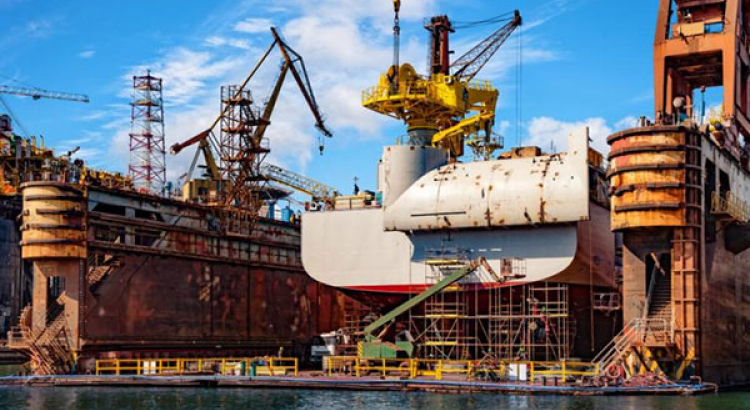 IntroductionProject introduction:has demonstrated its ability to conduct successful drilling operations in some of the most demanding environments on the planet.Why Choose UsThe other project in the oil sector is the long-planned construction of the petroleum products pipeline system through MexicoOil & Gas Industry
 IntroductionPower industry projects demand steel pipes that deliver high strength, heat resistance, and long-term reliability under extreme operating conditions. Designed to withstand high temperature, high pressure, and corrosive environments, these pipes ensure safe and stable energy transmission.Power Industry
 IntroductionSteel pipes used in offshore and marine projects are engineered to withstand extreme conditions, including high pressure, saltwater corrosion, and harsh environments. From subsea pipelines to offshore platforms, these pipes deliver safe, efficient fluid transmission for critical operatioOffshore & Marine
